Autumn promo 82% off, held for you for 47:59:59
Myofascial Protocol

Lower back pain · Tight hips · Stiffness

For the woman whose lower back never quite lets go
About 10 minutes a day for four weeks, in a chair or lying down, and it starts at your feet.

A woman in her fifties sitting on the edge of her bed in the morning light, one hand on the mattress and the other on her lower back, about to get up.

Massage, stretching and the gym each bought you a good week. None of them reached the reason your back keeps holding on. This program is gentle work on the holding itself, with a rolled hand towel and a ball, in a chair or lying down. Your phone guides you step by step. It starts at your feet, nowhere near the part that hurts.

  1. Your lower backwhere you feel it, never on the spine
  2. Your hips and the backs of your thighs
  3. Your belly, ribs and breaththe front of the brace
  4. Your calves
  5. Your feetwhere you start
The work climbs the chain, and the back comes last.

You feel it before you open your eyes.

You roll onto your side, knees together, and push yourself up with one arm. Somebody showed you that once, and you never stopped doing it. It's not sore, exactly. It's set, as if your back spent the night holding something up.

Then you check the rest of you. The band across the base of your spine. Your hips, stiff at the front where your legs meet your body. Your shoulders. And your jaw, which you only notice when you let it go.

Putting your socks on takes planning now. You sit on the bed to do it.

By 11am you've been sitting through a meeting, and standing up takes two tries and a hand on the desk. By 3pm the ache has settled in, low and wide, and you're shifting from one side to the other. You cross your legs and uncross them. By 6pm you're lying on the floor with your knees bent, because it's the only position that asks nothing of you.

The same woman half-risen from a wooden desk chair, one hand on the desk beside a laptop and the other pressed into her lower back, looking toward the window.

At the store you lift the bag the way you were taught, knees bent and back straight, and it still catches.

Getting out of the car, you have a way of doing it now. Swivel, both feet down, push. You have never once said it out loud.

On Saturday there was something you would have said yes to. You did the math first. You know what the next day costs. You said no.

You've tried to fix it, and you gave each thing a real chance.

Deep tissue massage left you feeling worked on for two days, sore on the third, and stiff again by Friday. You rolled a foam roller through the pain, because that's what you were told to do. Months of hamstring and back stretches gave you some range back, then took it away the moment you stopped. Anti-inflammatories and a heating pad got you through the bad afternoons. Core work and a rehab plan at the gym made you stronger without making anything easier. You could add up what all of it has cost you by now. You'd rather not.

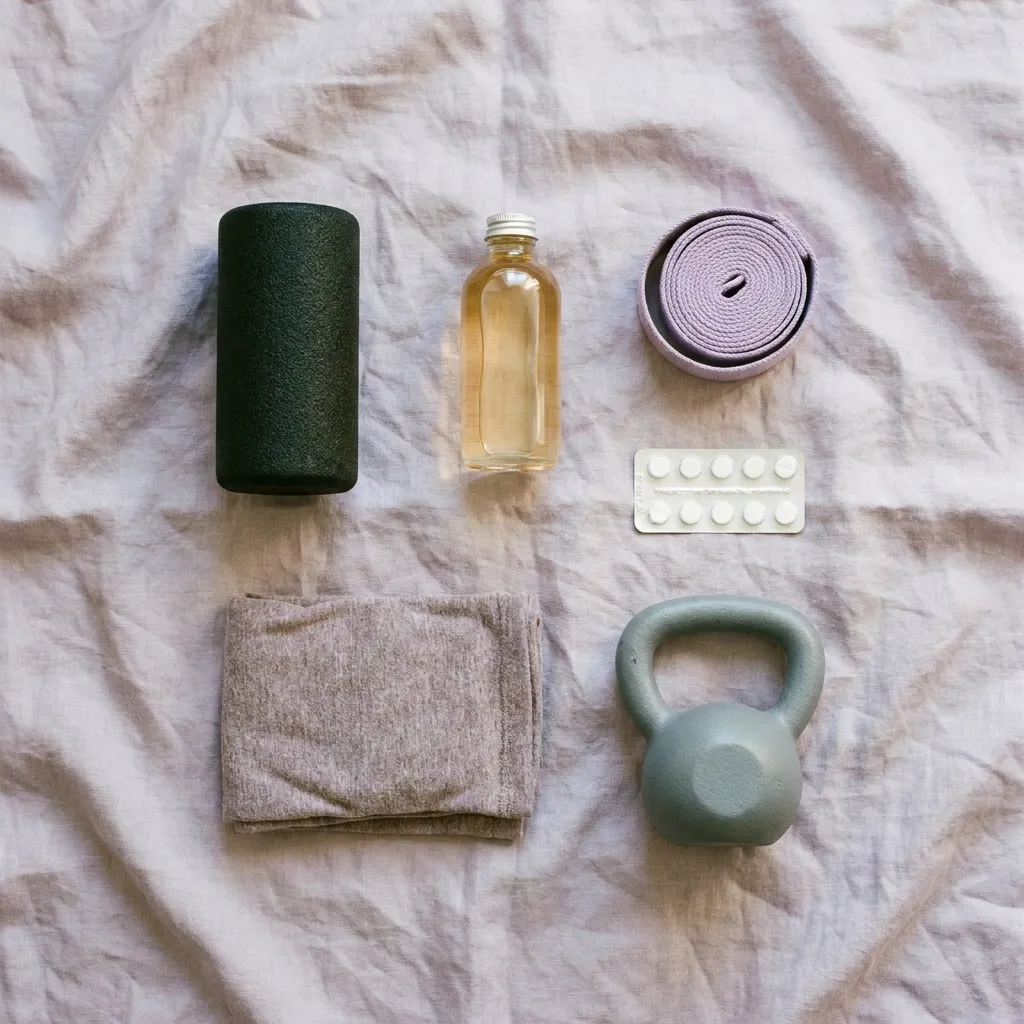
A foam roller, a bottle of massage oil, a stretching strap, a pack of tablets, a heat wrap and a small kettlebell, laid out on linen.

Each one helped for a little while. Then the tightness came right back.

Here's the part you don't say out loud. You're not really scared of the stiffness. You're scared that it's permanent. That this is your body now, and that in five years it will be worse. Without anyone telling you to, you've already started leaving things out, one at a time.

Maybe your doctor checked you, even sent you for a scan, and everything came back normal. That should have been good news. Instead, it left you with no reason for the ache and no idea when it would stop.

Look at that list of things you tried again. It isn't a list of your failures. Every one of them worked on the tissue, by pressing it, stretching it, numbing it or strengthening it, and none of it lasted. When five different fixes fade the same way, they are pointing to the same answer.

The tissue itself is not the problem.

Nothing in you is torn. Your body is braced, the way you tense up when you expect to be hit.

Bracing is not damage. Your nervous system braces you to keep you safe. When nothing tells it the danger is over, it keeps you tight, just in case. Your joints get stiffer, your breathing gets shallower, and you move as if you might need to pull back fast.

Fascia is the thin web of tissue that wraps your muscles, from your scalp to the soles of your feet. When you stay braced for a long time, it stiffens to match. Think of a hand you've kept in a fist all day. It isn't injured, but it's stiff, and it takes a while to open again.

That's why nothing showed up on a scan. A scan shows damage. It can't show how tightly your body is holding on.

It also explains why the massage wore off by Friday, why the roller made you grip harder the longer you rolled, why the stretch only lasted while you held it, and why getting stronger didn't make anything easier.

It also means your biggest fear may not be true. If you've been checked and nothing was found, your back may not be wearing out at all. Bracing is something your body is doing right now, and that can change. You don't have to take that on faith. Further down this page there's a 90-second test you can try sitting in your own chair.

You can't force it to change, though. Force is the one thing everything you tried had in common.

The rest of this page shows you how to change it without force. You'll see what the research found, learn the method, and meet the person behind it. You'll see why it starts at your feet when it's your back that hurts. Then you'll see exactly what four weeks of this asks of you.


The research caught up

For most of the last century, fascia was thrown away
then researchers took a closer look at what they had been throwing out

In anatomy labs, the thin white layer that wraps every muscle was cut away and set aside, to get a clear view of the muscle underneath. People called it packing material. Nothing in the textbooks said it did anything worth measuring.

That changed slowly. In October 2007, the first International Fascia Research Congress was held at the Harvard Medical School Conference Center. It brought anatomists, cell biologists and hands-on therapists into one room to study the same tissue. From then on, two questions led the field: what is fascia made of, and what controls how stiff it gets?

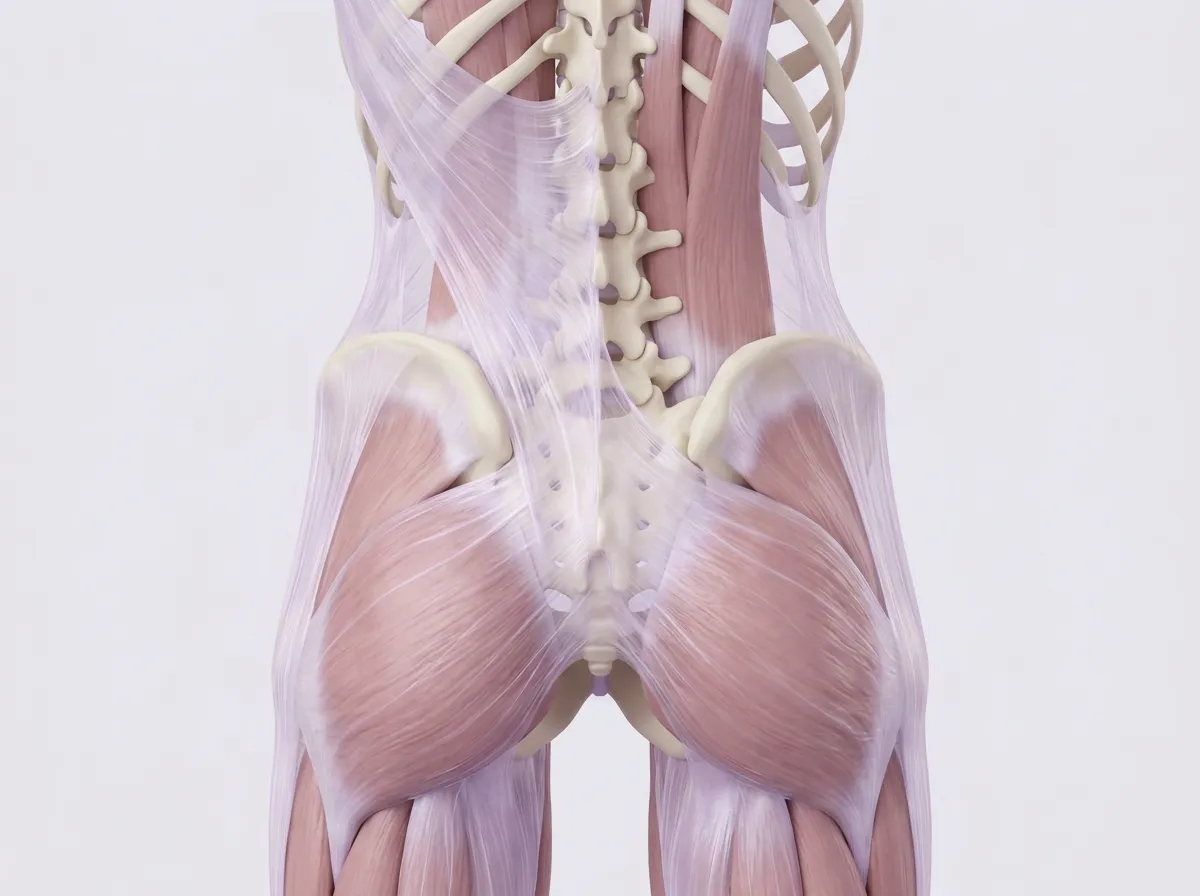
An anatomical model of the lower back and hips from behind, the muscles beside the spine and across the hips wrapped in one sheet of fascia.
An illustration of the muscles of the lower back and hips, wrapped in one sheet of fascia.

Dr. Ida Rolf

Structural Integration · PhD, biological chemistry, Columbia University, 1920

Rolf believed something the anatomy of her time did not back up: that the body is one continuous fabric, and that fascia is what holds its shape. She argued that fascia responds to slow, steady pressure rather than force, and that pain in one place often starts somewhere else. She said this decades before anyone had the tools to test it.

Rolf, Rolfing: Reestablishing the Natural Alignment and Structural Integration of the Human Body for Vitality and Well-Being, Healing Arts Press, 1989

Prof. Carla Stecco

University of Padua · orthopedic surgeon and anatomist

Stecco spent years dissecting unembalmed bodies to map fascia layer by layer, and published it as a full atlas. She found the tissue is rich in nerve endings, the kind that sense pressure, stretch and position. On this evidence, fascia is one of the body's sensing organs, not just the wrapping around them.

Stecco, Functional Atlas of the Human Fascial System, Churchill Livingstone / Elsevier, 2015

Dr. Robert Schleip

Fascia Research Group, Ulm University

Human hands can't press hard enough to physically reshape dense fascia, yet the tissue clearly changes under them. Schleip's answer, published in 2003, was that the change happens through the nerves. Slow, steady pressure stimulates the nerve endings in fascia. That changes the signals the nervous system sends out, and that changes muscle tone. The pressure is a signal, not a force.

Schleip, 'Fascial plasticity: a new neurobiological explanation', Journal of Bodywork and Movement Therapies, 2003, parts 1 and 2

Dr. Stephen Porges

Polyvagal theory · Indiana University

Porges gave a name to the way the body judges danger without your conscious mind: neuroception. In his account, the body doesn't shift toward rest because you decide to relax. It shifts when it picks up enough signs that you are safe. He also traced the link between the breath and the heart, which is why how long you breathe out is part of the signal.

Porges, The Polyvagal Theory, W. W. Norton, 2011

Dr. A. D. Craig

Barrow Neurological Institute · interoception

Craig mapped the pathway that carries signals about the body's inner state up to a part of the brain called the insular cortex. In 2002 he argued that this is a sense of its own: interoception, your sense of what is going on inside your body. When that sense reports poorly, a body can stay braced for years without its owner noticing.

Craig, 'How do you feel? Interoception: the sense of the physiological condition of the body', Nature Reviews Neuroscience, 2002; and How Do You Feel?, Princeton University Press, 2015

Wu and colleagues

Frontiers in Medicine · a review of eight trials, 2021

In 2021 a team in Guangzhou, China, pooled eight randomized trials of myofascial release for long-term low back pain, with 375 people in all. It gave small but real improvements in pain, and in how well people managed everyday physical tasks. It made no clear difference to quality of life, balance, mobility or mood. The authors said the trials were few and of low quality. Those trials tested hands-on care from therapists for long-term back pain. This program is not that care, and it does not replace it.

Wu Z, Wang Y, Ye X, et al., 'Myofascial Release for Chronic Low Back Pain: A Systematic Review and Meta-Analysis', Frontiers in Medicine, 2021 (PMID 34395477)

Fascia is a web full of nerve endings. How tightly it holds follows your nervous system's sense, moment to moment, of whether you are safe.

The anatomy is not in dispute, and the clinical trials are starting to point the same way. But almost none of it has reached the people who live with a body that won't let go. It sits in textbooks, conference papers and medical journals. It hasn't been turned into something you can do in a chair, with a rolled hand towel, on an ordinary Tuesday afternoon.

You've already tried the usual fixes.
Each one went after the pain. None of them reached what keeps you braced.

Find the tight spot. Push harder. Stretch further. Break up the knot.

That's the advice almost everyone gets, and you followed it. It trains you to ask your body one question: how much can I take?

But every time you pushed through, your body braced a little harder.

The advice was wrong, not you.

  1. Something keeps you on guard

    Stress, a strain, an old injury, or years of sitting still. Nothing tells your body the danger is over.

  2. Your muscles tighten

    Your nervous system holds you tighter, just in case. Your joints stiffen, and your breathing gets shallow.

  3. The fascia stiffens to match

    The web of tissue around your muscles holds on to that tension. It isn't torn or scarred, just stiffer, with less give.

  4. This is what you feel

    A back you get up around in the morning. Hips stiff by 11am. A low, wide ache by 3pm.

Your body feels that holding as one more reason to stay on guard, so the loop starts again.

Where the four weeks cut in

Slow, gentle pressure, away from where it hurts, as you breathe out. The holding eases, and your back lets go.

Deep tissue and sports massage

Massage works on the muscle by pressing hard. It really does change how your back feels for a day or two, and there's real relief in being worked on by someone who knows what they're doing. But think about what you did on that table. You held your breath. Holding your breath is a sign your body feels under threat, not safe. The muscle got pushed, nothing told your body it could stop bracing, and by Thursday you were back where you started.

The foam roller and hard trigger point work

This is the same idea, except you were the one pressing. Rolling is good for warming you up, and it gives a body that sits in the same three positions all day something new to feel. But you were told to roll through the pain. When you press hard into a back that's already guarding, your body treats the pressure as one more threat, and it grips. You weren't doing it wrong. You were pressing on a place your body had already decided to protect.

Hamstring and back stretches

Months of them, for some of you. You pulled, held it and counted. Stretching is about length, and it's good for keeping the range you already have. But length was never what was missing, which is why the range went away the moment you stopped. A braced back meets a hard pull by bracing harder. You were working on the muscle, but the muscle isn't what decides how tight it stays.

Painkillers and heat

They work on body chemistry and turn down the pain signal. They took the edge off a bad afternoon, and there's nothing wrong with wanting a bad afternoon to be shorter. But they never touched the reason 3pm is when your back starts. They turn down the alarm. They don't tell your body the danger is over.

Chasing the sore spot

It makes sense to treat the place that hurts, so everything went to your lower back. But fascia is one connected web, and it shares the load. A back rarely braces from behind alone. It braces along with hips held short at the front from hours of sitting, a belly held in all day, and a breath that never reaches the bottom of your ribs. That's the front of the brace, and nobody worked on it. The pain stayed in your back because part of the reason for it was in front of you.

Core work and the rehab plan

These build strength, and strength is real and worth having. You got stronger. But getting stronger doesn't lower the tension your muscles hold at rest. You added more load to a body that was already holding itself together by force. Nothing got easier, and you paid for the days you pushed with a week of aching. If a physical therapist gave you exercises, follow them: that's their call, not this page's.

None of these was a silly thing to try. Each one worked on the muscle, on body chemistry or on strength.

But the bracing is set by your nervous system, and nothing had told it the danger was over. None of those fixes reached the part of you that keeps you braced. The problem was never that you didn't try hard enough, stretch often enough or stick with it long enough.

How the method works

You can't force a braced back to let go.
You take away its reason to hold on, and it lets go by itself.

Fascia was treated as packing material for a long time. That was wrong. Fascia is full of nerve endings. They sense pressure, stretch, movement and where your joints are. In some places, fascia has as many of them as your skin does.

These nerve endings report to your brain all day long. Your brain uses what they report to answer one question: am I safe?

A woman sitting in an armchair with her eyes closed, shoulders low, one hand resting on her stomach as she breathes out.

Muscle tone, how tight your muscles are at rest, is the answer. When your brain thinks you need protecting, your muscles tighten. When it stops thinking that, they ease off. Your nervous system sets muscle tone, and your fascia holds on to it.

That means the massage, the roller and the stretches were never working on dead packing material. They were pressing on nerve endings, and your brain read that pressure before any tissue was allowed to change.

When the pressure is hard enough that you hold your breath, your brain gets one message: it still hurts there, so keep protecting it. Your muscles tighten. A hard pull sends the same message. Your brain did the right thing with what it was told. It just wasn't what you wanted.

This program works the other way around. It has three rules, and every session follows them.

Rule one: go slow and gentle enough that you keep breathing easily. That's the test. The question is how much you can do while staying relaxed, not how much you can take. Most of this program is a 1 or a 2 out of 5. On your belly, it's never more than the weight of your own hand.

Rule two: start away from the sore spot. A back that already hurts is sending a loud signal all day, and a bit more pressure there won't change it. The soles of your feet are quiet. A small, gentle signal there is one your brain will notice. That's why the first week is your feet, your calves and your hands, when it's your back that hurts. Your low back itself comes last, in week 3, and only beside your spine, never on it.

Rule three: time it with your breath going out. A slow breath out is a signal to settle in its own right. You choose where to press, and you also choose when.

Try it now, before you decide anything.

The woman sitting on the front of a chair, folding gently forward on a breath out, her hands sliding down to the middle of her shins.
Hands sliding down the legs on a breath out, only as far as is easy.
  1. 1Sit on the front of a chair with your feet flat. Breathe out and let your hands slide down the front of your legs, only as far as is easy. No bouncing and no pushing. Notice where your fingertips stop: your thigh, your knee, or somewhere on your shin. Then sit up slowly. If leaning forward hurts at all, skip this test.
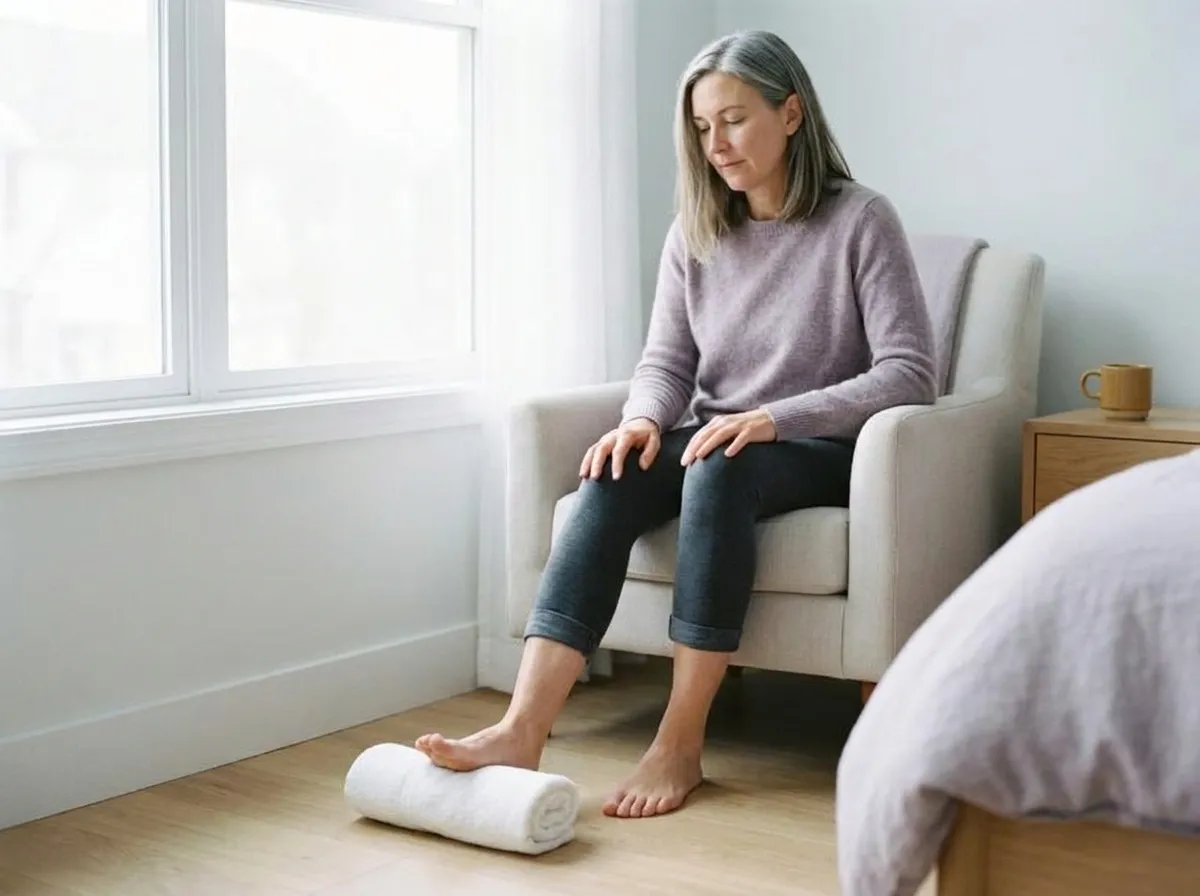
  2. 2Roll a hand towel into a tube and put it on the floor. Rest the sole of one foot on it and roll the towel slowly, heel to ball and back, for about 60 seconds. Breathe slowly. Stay well away from your back.
  3. 3Put your foot flat on the floor and take one easy breath. Then breathe out and let your hands slide down your legs again, only as far as is easy. Notice where your fingertips stop now.

Maybe something changed, and maybe it didn't. Either way, you have your answer, and it took 90 seconds. You pressed gently in one place and checked for a change somewhere else. That's the whole method, and it's how Week 1 works. Notice what you didn't have to do: you never touched your back.

You might be thinking this sounds too gentle to do anything. That's fair. Everything that ever helped you, even for two days, was intense. A rolled hand towel under the sole of your foot sounds like a waste of an afternoon.

But gentle is the point. For years, your body has been reading intense pressure as a threat. This program doesn't ask how much pressure you can take. It asks how little you can use and still notice a change.

The practitioner

The person behind every step
I'm a Clinical Neuromuscular Therapist and Orofacial Fascia Specialist.

Almost every step in this program comes from two ideas. It helps to know them before you start.

The first is to start away from the pain. A back that aches is already sending loud signals, so I start where things are quiet: the soles of your feet, your calves, your hands. Then the back of your legs, then your hips, your belly and your ribs. Your low back comes last, and even then your hands work beside your spine, never on it.

The second is the breath out. You breathe in for five seconds and out for five, and you press, sweep or squeeze as the breath leaves. The pace is slow for that reason, and the steps keep saying "notice" instead of "push."

Everything else comes from those two ideas, including the rule that you never force anything, and never stretch to your limit.

When your instinct says to press harder or pull further, remember this: slower often works better than deeper.

On your phone

Something a clinic can't give you.
Help on the days in between.

A woman in an armchair reading her phone, a folded towel over the arm of the chair.

A good therapist can help you feel looser for an afternoon. But the stiffness comes back at your desk, in the car and at 3pm, and nobody is there with you then.

This program is. Every session is on your phone. Each step shows you where to put your hands, how hard to press and when to breathe, with a timer running. There's nothing to remember and nothing to look up. You just follow the screen until it says stop, sitting in a chair or lying on your bed.

On a long day of sitting, there's the desk minute. On a bad day, there's a two-minute version. At night, there's a four-minute routine you do in bed.

And because letting go is often quiet, the app keeps a quick score before and after each practice. On a day it feels like nothing has changed, you can look back and see whether it has.

Day 1 of 28Example

The feet first session. Done.

Tension before

7

After

4

Seated reach

How far your fingertips reach, before and after

Tomorrow: Catch it
The finish screen after every practice. Example numbers.

Every step on the screen

Where to put your hands, how hard to press and when to breathe, with a timer running.

From a chair or your bed

Every practice is done sitting or lying down. Nothing presses on your spine, ever.

For the hard moments

The desk minute for long sits, a two-minute version for bad days, and a bedtime routine for the end of the day.

Your own top three

In week 4 the app looks back at your practices and shows you the three tools that helped you most.

Quiet proof

A quick score before and after each practice, on a chart that belongs to you.

Inside the program

The Lower Back Protocol
four weeks, a hand towel, a ball, and a body that stops bracing

You get four weekly sessions, a short practice for the days in between, and a workbook. Your phone guides you through every session, step by step, with a timer, so you never have to remember what comes next. You do it sitting in a chair or lying on your bed or the floor, and none of it is harder than making a cup of tea. Each session goes in order, from the quiet places to the sore ones, so every weekly session starts somewhere other than your back.

A hand towel rolled into a cylinder, a tennis ball, a pillow and a glass of water on linen.

Before you begin

The rules, before you touch anything

You don't do anything to your body yet. First you meet the tools: your own hands, a hand towel, warm water from the tap, a tennis ball or a pair of rolled socks, a wall, and a pillow. You learn how light the pressure is. Most of this program is a 1 or a 2 out of 5, and on your belly it's never more than the weight of your hand. Then you read the full safety guide: where never to work, and the signs that mean see a doctor first. The rule from then on: slow down instead of working harder, never press on your spine, and never work through real pain.

The woman sitting in an armchair, rolling the sole of one bare foot over a rolled hand towel, her hands resting on her knees.

Week 1

Starting where it doesn't hurt

A back that hurts is sending a loud signal all day. The soles of your feet are quiet, so a small signal there is one your brain will notice. The first session starts with a long breath out and a rolled towel under the sole of one foot, heel to ball. Then your calves, squeezed gently as you breathe out. Then your hands. You are nowhere near your back the whole time. It ends lying down, knees bent and resting against each other, in the one position that asks nothing of your back. You check how far you can reach sitting down, before and after, so you know on day 1 whether anything moved.

The woman leaning gently back against a wall with a tennis ball between the wall and the back of her hip.

Week 2

Why pulling harder made it worse

A body that feels unsafe answers a hard pull by pulling back. The back of your legs and your hips are the chain your back hangs from. So this week does the opposite of what you were told. No stretching to the end of anything. Instead, slow sweeps with a folded towel up the back of your thigh. A tennis ball against a wall, in the meaty part of your buttock, never on your tailbone. Slow circles on the side of your hip. Then, lying down, a gentle knee hug, rocking only as far as is easy.

Week 3

The front of the brace

A back rarely braces from behind alone. It braces with hips held short at the front from hours of sitting, a belly held in all day, and a breath that never reaches the bottom of your ribs. So your hands go around your lower ribs, and you breathe sideways into them. A flat hand makes slow circles on your belly. Your fingertips rest in the crease where your thigh meets your body, toward the outside. Then, last, your back itself: slow sweeps down the side of your waist, and a ball against the wall in the thick muscle beside your spine, never on it. This week also gives you the desk minute, standing up in one go, and a four-minute routine for bed.

Week 4

The sequence you keep, soles to jaw

This week you do the full sequence, from your feet up: your soles, your calves, the back of your thighs, the hip crease, your belly, your ribs, the side of your waist, the wall ball for your hips and beside your spine, the knees-together rest, and your jaw, with your tongue resting on the roof of your mouth. Your hands come last. Then the app looks back at your practices and shows you your own top three. Those become your five minutes, the short routine you keep. There's also a two-minute version for bad days, and a flare-up plan you write on a calm day.

The workbook

The pages you write in

A page for where and when you catch yourself bracing. The desk minute and the bedtime routine, ready for the days you need them. A flare-up plan you write before you need it. The signs that mean see a doctor first, in one place. And the four-week report, which puts your day 1 and day 28 side by side.

What usually changes

The first changes people notice are usually small,
and they show up in everyday moments.

These are changes people commonly report with this kind of work, in roughly the order they tend to show up. This isn't a schedule or a promise, and no two days are the same.

The woman smiling in her kitchen as she reaches up easily to take a bowl down from a high shelf.

Rolling onto your side and pushing up with one arm.

Sitting up in bed without planning it.

Sitting on the bed to put your socks on.

Putting your socks on and not noticing you did.

Two tries and a hand on the desk to stand up.

Standing up in one go.

The 3pm ache in your low back that ends your afternoon.

Three o'clock arriving, and being a normal hour.

Pulling yourself out of the car by the door frame.

Getting out of the car without planning how.

Lying on the floor with your knees bent after work.

Sitting on the couch like everyone else.

Lifting the groceries and waiting for the catch.

Lifting the groceries and carrying on.

Your breath stopping around the middle of your chest.

Your breath reaching the bottom of your ribs while you stand at the sink.

Lying down at night and waiting for your body to settle.

Lying down and settling without having to work at it.

The change is rarely dramatic. It looks like a body that needs to hold on a little less.

The program

The Lower Back Protocol
Four weeks of gentle work on the holding in your lower back, guided step by step on your phone, starting at your feet.

You could book a massage instead. You'd block out an hour, travel there and back, and have someone skilled work on your back. You'd walk out looser, and by Thursday the stiffness would be back. That's not because they were bad at it. The change happened on their table, and nothing in the days between taught your body anything new. Your back doesn't tighten by appointment. It tightens at your desk, in the car and at 3pm. Your body lets go of bracing when it gets the signal often enough to trust it, and that means the practice has to be something you do yourself. That's why this program is a chair, a towel, a ball and a few minutes a day, for one payment.

A phone, a rolled hand towel, a tennis ball, a notebook, a pencil and a mug of tea on linen.

The program

The full four weeks, yours for life.

  • Four weekly core sessions: the feet first session, the back of the legs session, the front of the brace session, and the full sequence you keep for any stiff day
  • A short daily practice for the days in between, about 10 minutes, with a rolled hand towel, a tennis ball and a pillow
  • The desk minute for long days of sitting, standing up in one go, the two-minute version for bad days, and a bedtime routine for the end of the day
  • The workbook pages: where and when you brace, a flare-up plan, the signs that mean see a doctor first, and the four-week report
  • Three simple numbers on a chart of your own: how far you reach sitting down, how stiff your back is when you get up, and your aching days this week
  • Every practice done sitting in a chair or lying down. Nothing on your spine, and no stretching to your limit
  • The breathing you use throughout: five seconds in, five seconds out, pressing as you breathe out
  • The safety guidance in full: how to test your pressure, where never to work, and when to speak to a doctor first
  • Lifetime access for one payment, with nothing recurring
  • 30-day refund, by email to hello@send.myofascialprotocol.com

$97 Save $80.01 (82%)

$16.99

One payment. Nothing recurring.

$16.99 is your price for the next 47:59:59. After that it is $97.

Why it costs what it does.

Compared with any other way to get this kind of help, the price on the button is small. One hour of hands-on myofascial release at a clinic often costs more than that by itself, and by Thursday it has worn off.

Myofascial Protocol wants more people doing this work, not fewer, so the price is the one on the button: one payment, lifetime access, nothing recurring.

How it compares

  • One hour of myofascial release with a therapist: often more than this whole program
  • A deep tissue massage every few weeks: often just as much, every time you book
  • The foam roller, the ball and the heating pad: already bought, and you know how that went
  • Doing nothing for another year: free, and you already know how that feels

What happens when you click the button.

You go to the Myofascial Protocol checkout. First there's a quick safety question. Then you enter your email and pay. After that you'll see a couple of short pages with offers you can skip, and then you're signed in with Day 1 waiting. You can be sitting in a chair with a rolled towel under your foot within ten minutes of clicking.

$97 $16.99 · yours for 47:59:59

Start the Lower Back Protocol · $16.99

One payment. Lifetime access. 30-day guarantee.

The guarantee, in plain words.

You have 30 days. You don't have to prove you did the work, and nobody checks up on you.

If it's not for you, email hello@send.myofascialprotocol.com. There's no form to fill out and no phone call, and nobody will try to talk you into a pause instead of the refund you asked for.

If something got in your way, we will offer to fix it first. If you'd still rather have your money back, the answer is yes, and we refund what you paid.

We ask one thing: do the first session, and give the towel a few honest days under your feet. You don't have to prove anything to us. Most of the change happens quietly, and a few days is about how long it takes to notice whether your back is holding on a little less.

From here, it's your choice.

You can close this page and go back to the week you've been living: a back you get up around, socks on sitting down, and two tries to stand up from your desk. Nobody here will argue with that.

Or you can press the button, sit down with a rolled towel today, and find out for yourself how much of what you feel is your body bracing. If it doesn't work for you, the 30-day refund is there for exactly that.

An empty armchair by a bright window, a folded towel on its arm and a mug of tea on the table beside it.
Start the Lower Back Protocol · $16.99

One payment. Lifetime access. 30-day guarantee.

Thank you for reading this far.

We know this is a long page. If you read it from the top, that's more attention than most people in pain can spare at once, and it says a lot about how much you want this to change. The rest of the page answers common questions.

Start the Lower Back Protocol · $16.99

One payment. Lifetime access. 30-day guarantee.

The questions you'd ask if we were sitting together,
answered the way I'd answer them in person.

It's my lower back. Is this for that?

Two answers, and they're different.

What this program works on is the holding, and a back is rarely braced from behind alone. Week 3 works the front of it: your lower ribs, slow circles on your belly, and the crease where your legs meet your body, with a steady breath of five in and five out. Week 4's full sequence runs from the soles of your feet, through your calves, thighs and hips, to your ribs and your jaw. Your low back itself is worked gently, beside your spine and never on it.

What it is not is a treatment for a back condition, and it doesn't replace a doctor or a physical therapist. If you're seeing one, follow their plan, and ask them before you add anything, this included. Back pain after a fall or an injury, numbness or weakness in your legs, numbness in your groin or seat, a new change in your bladder or bowel control, pain with a fever, losing weight without trying, or pain that's worse at night and doesn't ease with rest is a question for a doctor first, and some of those are urgent. What this program gives you is four weeks of gentle work on the tension around it, the part you can put your hands on.

My body already punishes me for doing too much. Will this cost me the rest of the week?

The gentlest week asks less of you than drying the dishes. Week 1 is your feet, your calves and your hands, sitting in a chair, then lying down with your knees bent. If that's still too much on a given day, roll the towel under your feet for a minute and stop there. The test for pressure is simple: you can breathe normally and stay relaxed. The moment you're holding your breath, the pressure is too much, so you ease off. You never push through anything here, because a body that reads force as a threat just braces again.

I've done deep tissue and foam rolling. Why would something this gentle do what the hard stuff couldn't?

Because the hard stuff worked on your tissue, and your tissue isn't what's doing the holding. Your nervous system sets how tight your muscles are. Pressure so hard you hold your breath gets treated as one more threat, so your muscles tighten instead of relaxing. This program works the other way: slow, gentle, away from where it hurts, and timed to a long breath out. Your body registers that it's safe first, and then it lets go on its own. That's why the first session starts at your feet when it's your back that hurts. If you want to know before you spend anything, try the 90-second test further up the page.

I already do physical therapy, yoga or a class. Will this get in the way?

No. It works alongside them. It isn't exercise. There's no lifting and no stretching to your limit, and you do it sitting or lying down, with a towel, a ball or your own hands. You can do it before a session, or in the evening after one. If a physical therapist gave you exercises, keep doing them: that's their call, not this page's. If you take blood thinners or you're pregnant, ask your doctor before doing any pressure work. If you have osteoporosis or have broken a bone in your spine, ask your doctor first too, because some steps lean gently into a ball against a wall. Take extra care if you bruise very easily, have clotting or circulation problems, have had recent surgery or an injury, or have pain that's severe or unexplained. The first page inside lists all of this clearly, before you touch anything.

How long before I feel something different?

Often in the first session, though maybe not in the way you expect. The first change to look for is small: your fingertips reaching a little further down your legs after the first session than before it, or a breath that sits a little lower. I'll be honest with you. Letting go is usually quiet, and how intense a session feels doesn't tell you how much it helped. The bigger changes, like less stiffness when you get up, standing up without planning it, and settling at night, tend to come over the four weeks, not in one afternoon.

What if it does nothing for me? Do I have to argue for my money back?

No. You have 30 days. We only ask that you do the first session and give the daily practice a few honest days. If nothing has moved and your back feels no different, email hello@send.myofascialprotocol.com within the 30 days. If something got in your way, we will offer to fix it first. If you still want your money back, we refund what you paid. There's no target to hit and no form to fill out defending your effort.

Start the Lower Back Protocol · $16.99

One payment. Lifetime access. 30-day guarantee.

If you skipped straight down here, this is the short version. Nothing in you is torn. Your body is braced. Your nervous system does this when nothing has told it the danger is over, and your fascia stiffens around it. That's why scans can come back clear, and why massage, rolling, stretching and the gym each helped for a couple of days before the tightness came back. They all pushed, and a braced body treats pushing as one more reason to brace. This four-week program does the opposite. It's slow and gentle, it starts away from where it hurts, and it's timed to your breath out. It never presses on your spine. All you need is a rolled hand towel, a tennis ball and a chair. It's one payment for lifetime access, and you have 30 days to change your mind.

Don't decide based on this page. Decide based on your own back. Sit on the front of a chair, breathe out, and let your hands slide down your legs, only as far as is easy. Notice where your fingertips stop. Then roll the sole of one foot slowly over a rolled hand towel for 60 seconds, nowhere near your back. Slide your hands down again. Whatever you find, that's the method in 90 seconds: you pressed gently in one place and checked for a change somewhere else.

If you have a question before you decide, or after, email hello@send.myofascialprotocol.com.