The alarm goes off, and your back teeth are already pressed together.
It doesn't really hurt. It just feels tight, like you were biting down all night without knowing it.
You open your mouth slowly to test it. Some mornings it clicks. Some mornings the joint just in front of your ear aches before you've said a word.
Then you check the rest of you: your temples, your neck, the tops of your shoulders, and your lower back, which you'll feel the moment you stand up.
By 11am your shoulders are up near your ears. By 3pm there's a dull ache along your jaw and into your temple. By 6pm you notice your tongue has been pressed hard against your teeth for an hour, and you never meant to do that.
In a meeting you catch your teeth together and pull them apart. Four minutes later they're back together.
At dinner you order something soft and say you're not that hungry. A crusty roll, an apple, a steak: you skip them now, because your jaw pays for them later.
Your dentist has seen the wear on your teeth. The edges are flatter, and there's a ridge inside your cheek where you bite down. They made you a night guard. You wear it, and you still wake up clenched.
You yawn carefully now, behind your hand, in two halves.
Some weekends you skip plans, because you know your jaw will pay for it the next day.
You've tried to fix it, and you gave each thing a real chance.
Massage for your jaw and neck felt great while someone's thumbs were on it, and the relief was gone by Friday. You bought a foam roller for your upper back and a ball for your temples, and you pressed through the pain because that's what you were told to do. Jaw stretches from a printed sheet gave you a little more opening, then took it back the week you stopped. You took anti-inflammatories on the bad weeks, and once a course of muscle relaxants. A physical therapist gave you posture and strength work. You got stronger, but nothing got easier. You could add up what all of it has cost you by now. You'd rather not.
Each one helped for a little while. Then the tightness came back.
What scares you most is the thought that this is how your body will be from now on, and that in five years it will be worse. Without anyone telling you to, you've already started giving things up, one at a time.
Maybe your doctor or dentist checked you, even sent you for a scan, and everything came back normal. That should have been good news. Instead, it left you with no reason for the pain and no idea when it would stop.
Look at that list of things you tried again. It isn't a list of your failures. Every one of them worked on the sore spot itself, and every one of them wore off. When five different fixes wear off the same way, they are pointing to the same answer.
The sore tissue itself is not the problem.
Nothing in you is torn or broken. Your body is bracing, the way you tense up when you expect to be hit.
Your nervous system braces you to keep you safe. When nothing tells it the danger is over, it keeps you tight, just in case. Your joints get stiffer, your breathing gets shallower, and you move as if you might need to pull back fast.
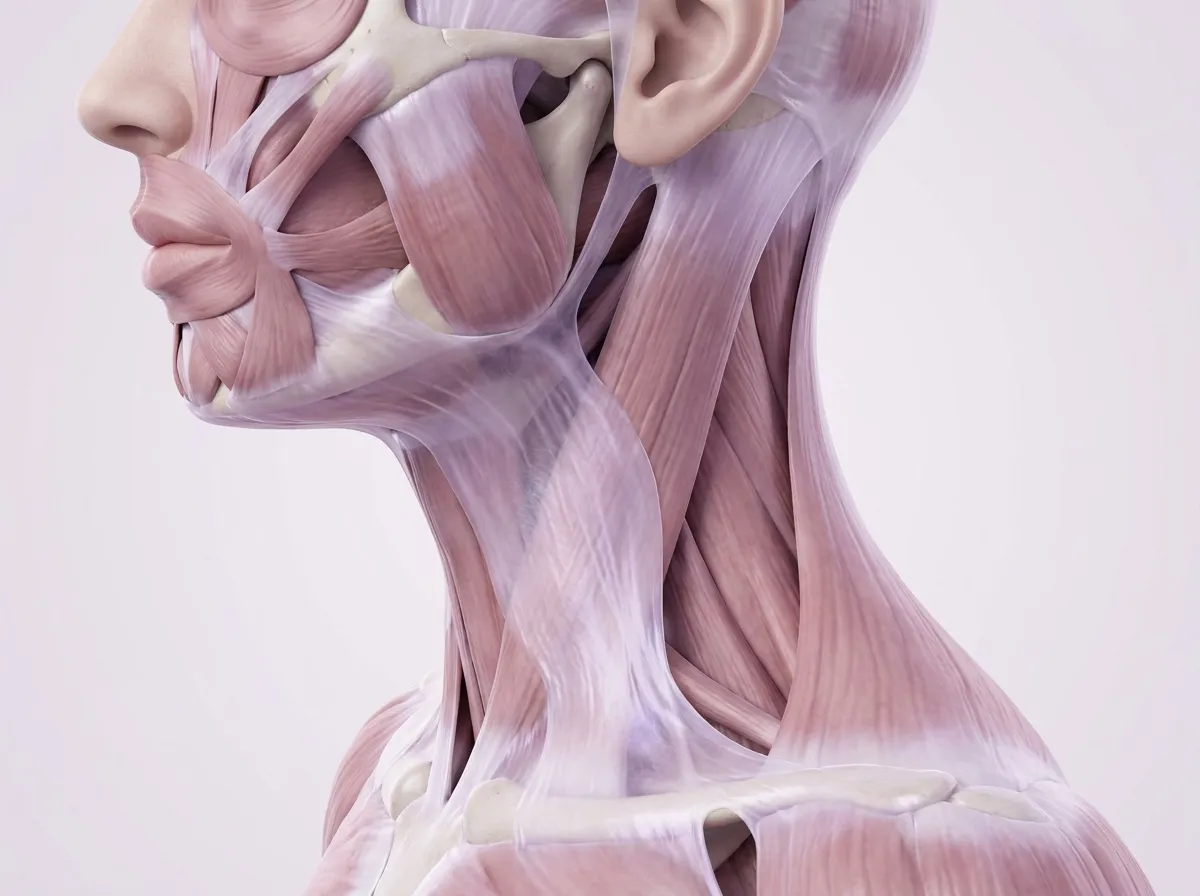
Fascia is the thin web of tissue that wraps your muscles, from your scalp to the soles of your feet. When you stay braced for a long time, it stiffens to match. Think of a hand you've kept in a fist all day. It isn't injured, but it's stiff, and it takes a while to open again.
That's why nothing showed up on a scan. A scan shows damage. It can't show how tightly your body is holding on.
It also explains why the massage wore off by Friday, why the stretch only lasted while you held it, and why getting stronger didn't make anything easier.
It also means your biggest fear is not true. Your body isn't wearing out, and this isn't the start of something worse. Bracing is something your body is doing right now, and that can change. You don't have to take that on faith. Further down this page there's a 90-second test you can try on your own jaw.
You can't force it to change, though. Force is the one thing everything you tried had in common.
The rest of this page shows you how to change it without force. You'll see what the research found, learn the method, and meet the person behind it. Then you'll see how the app keeps your own numbers, and exactly what four weeks of this asks of you.